Essay
The Fragility Beneath the AI Economy
Two supply chains sustain the AI buildout, one of capital and one of chips, and both pass through a strait twenty miles wide. On the compound vulnerability beneath the boom.
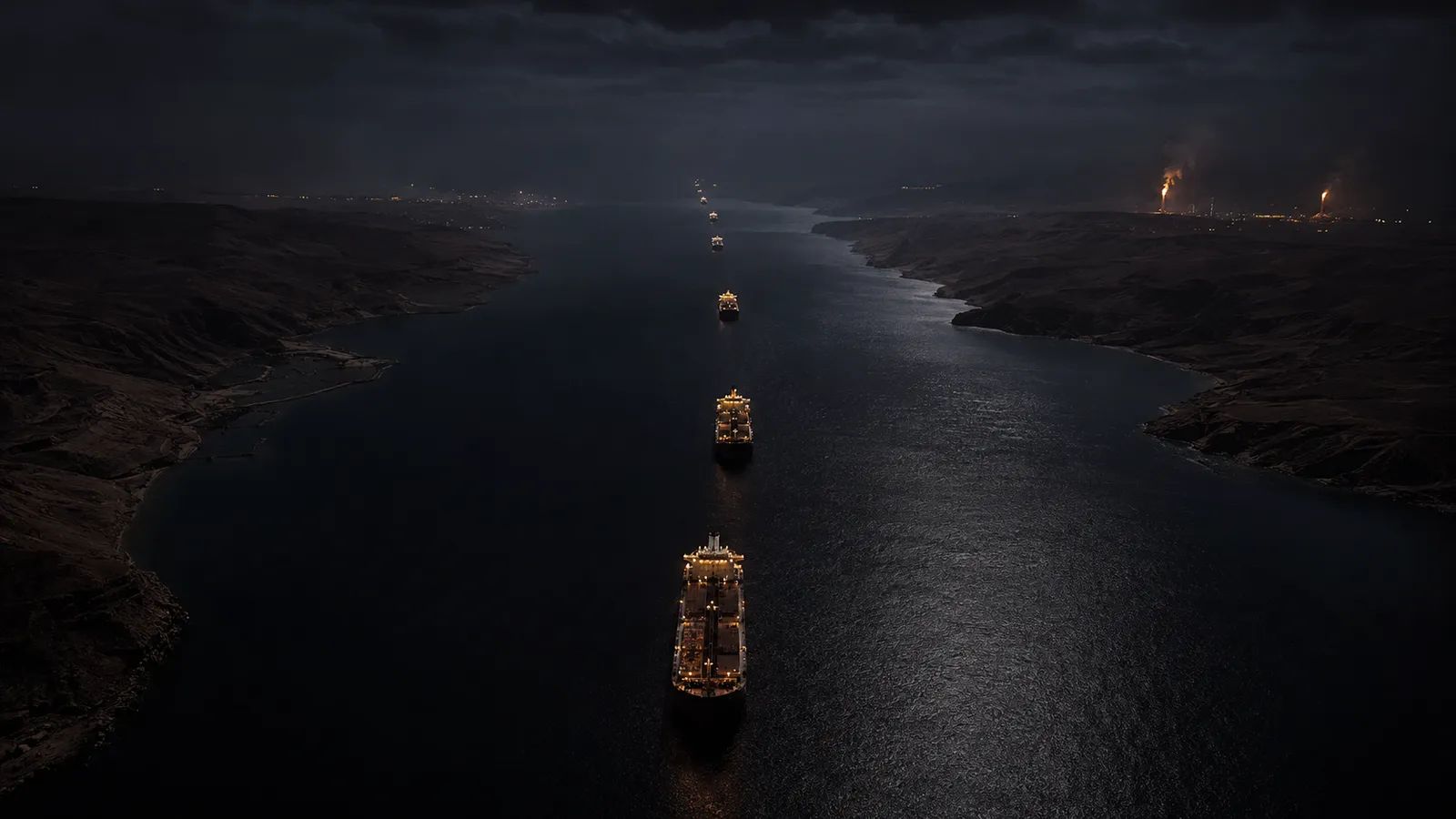
The largest infrastructure investment since electrification is underway. Hundreds of billions of dollars are flowing into data centers, chip fabrication, energy generation, and the organizational machinery required to train and deploy artificial intelligence at scale. The companies driving this buildout have become the most valuable entities in human history, and their market capitalizations depend, in significant part, on the assumption that the buildout will continue.
That assumption contains a vulnerability that I believe almost no one in the industry is discussing publicly.
The risk assessments I encounter in boardrooms and advisory engagements are thorough in the domains they cover, which run from model governance and data privacy to regulatory exposure, talent retention, and competitive dynamics. These are legitimate concerns and the people working on them are serious. The conversations, though, consistently stop at the boundary of the technology itself. They address the risks within the AI economy without examining the physical and financial infrastructure on which the entire economy sits.
That infrastructure rests on two supply chains, one carrying capital and the other carrying semiconductors, and both run through the same geographic corridor, which is twenty miles wide at its narrowest point.
A word on timing. I developed this argument before 28 February 2026, when US and Israeli strikes on Iran led, within days, to the effective closure of that corridor. The strait reopened briefly in June, closed again in July, and as I write it is passing a fraction of its normal traffic under naval escort. I have chosen to keep the analysis structural rather than rewrite it as a chronicle, because the dependencies it describes were there before the crisis and will be there after it. Where the past six months have already tested a link in the chain, I say so.
The Capital Chain
The AI buildout requires capital at a scale that no single economy can generate internally. The largest technology companies are spending tens of billions per quarter on infrastructure alone. Microsoft announced over eighty billion dollars in data center spending for fiscal year 2025. Meta’s capital expenditure guidance for the same period settled between sixty-six and seventy-two billion. Alphabet, Amazon, and Oracle have disclosed comparable figures. These are committed capital expenditures rather than aspirational projections, backed by signed contracts, purchased land, and construction already underway.
That money has to come from somewhere, and a meaningful fraction of it originates in a place that has nothing to do with technology.
The petroleum-exporting states of the Persian Gulf collectively manage sovereign wealth funds worth trillions of dollars. The mechanism is straightforward and has been operating for decades: these nations extract and sell hydrocarbons, receive payment predominantly in US dollars, and reinvest those dollars into financial assets. For most of that history the reinvestment went into public equities and bonds. Over the past two years it has moved one layer down, into the private financing rounds of the AI laboratories themselves and into the infrastructure vehicles that build for them.
The scale makes the connection concrete. Saudi Arabia’s Public Investment Fund manages assets exceeding one trillion dollars, the Abu Dhabi Investment Authority somewhere between seven hundred billion and a trillion, and the Kuwait and Qatar authorities together with the smaller Gulf states add several hundred billion more. The vehicle that matters most for AI, though, is MGX, established in 2024 by Mubadala, G42, and Abu Dhabi’s International Holding Company. In 2026 alone it co-led Anthropic’s thirty billion dollar Series G and participated in the sixty-five billion dollar Series H that followed, co-led OpenAI’s one hundred and twenty-two billion dollar round, took part in xAI’s twenty billion dollar raise, and stands as one of the four initial equity funders of Stargate, the five hundred billion dollar infrastructure program built for OpenAI. Saudi Arabia runs the other pattern through HUMAIN, which buys compute rather than equity: roughly twenty-three billion dollars in agreements with Nvidia, AMD, Amazon Web Services, and Qualcomm, with Aramco itself taking a stake so that the kingdom’s oil balance sheet is tied directly to its compute ambitions. These funds are structural participants in the financing of the AI economy rather than observers of it, and they hold their positions at the layer of it that has yet to turn a profit.
The reinvestment cycle has been running for so long that it has become, I think, part of the assumed background of the market. When a laboratory raises a round measured in tens of billions, or a hyperscaler announces a fifty billion dollar capital expenditure plan, the assumption embedded in the announcement is that the next round will close and the valuation required to justify the spending will hold. Analysts treat the sustained flow of petrodollars into that structure as a law of nature rather than a product of conditions. Remove it and the math changes considerably.
Now consider what happens to this capital chain under stress. The petroleum-exporting states generate revenue by moving hydrocarbons through maritime corridors. The single most important of these corridors is the Strait of Hormuz, a waterway approximately twenty miles wide at its narrowest point, through which roughly a quarter of the world’s seaborne oil trade and approximately a fifth of the world’s liquefied natural gas transits daily. Every barrel that moves through that strait generates the dollars that eventually find their way into the laboratories and data centers of the AI economy.
The geography is unforgiving. The strait sits between Iran to the north and Oman and the United Arab Emirates to the south. Tankers transiting in either direction must pass through designated shipping lanes that are each only two miles wide, separated by a two-mile buffer zone. The navigable channel is constrained by shallow waters, islands, and reefs. There is no way to widen it, no way to reroute around it, and no alternative passage of comparable capacity. Pipeline alternatives exist, among them the East-West Pipeline across Saudi Arabia and the Habshan-Fujairah line in the UAE, but they handle a fraction of the volume and were designed as emergency supplements rather than replacements.
When the strait closes, or becomes sufficiently dangerous that insurance rates and shipping costs make transit economically unviable, the revenue stops. That is what happened in March, when Gulf production fell by a reported ten million barrels a day within two weeks and QatarEnergy declared force majeure on its exports. The states that depend on maritime hydrocarbon exports face an immediate fiscal squeeze, and a sustained one changes what their funds do with the AI economy in two ways at once.
Sovereign wealth funds exist precisely for this purpose: to buffer national economies against disruptions to primary revenue streams. When the revenue stops, the funds liquidate what can be liquidated. They sell what is most liquid, what has appreciated the most, and what can be converted to cash the fastest, and in the current market that description fits the public shares of the companies building the AI infrastructure almost perfectly. The private stakes in the laboratories cannot be sold that way, and this is where the second effect arrives. What a fund under fiscal stress withdraws from an illiquid position is the money that comes next rather than the money already committed: the follow-on round, the capital call, the infrastructure tranche. For companies that lose more each year than they earn, the next round is the oxygen supply, and its withdrawal does more damage than any decline in a share price.
I would argue that the selling pressure from forced liquidation by sovereign wealth funds would be unlike a normal market correction. A correction reflects changing sentiment, whereas forced liquidation reflects changing survival requirements. The selling would be concentrated in the most liquid, highest-valued equities, precisely because those are the easiest to sell at scale, and the buyers who would normally absorb that selling pressure may themselves be facing tightened conditions for reasons connected to the same underlying disruption.
There is a counterargument I take seriously, and the first months of the closure supplied it. An analysis published in June, four months into the crisis, observed that the capital call from the venture partner in Menlo Park was the obligation Riyadh was meeting most reliably, because defaulting would signal to every Western counterparty something about Saudi credit and Saudi access that no fiscal saving could justify. The Gulf keeps paying the laboratories precisely because not paying is unthinkable. So far that is what the record shows: MGX closed a forty-nine billion dollar fund in July with the strait still shut. The capital chain therefore holds longer than a simple fiscal model predicts, and the strain surfaces elsewhere, in the public equities sold to fund those commitments and in the domestic budgets that absorb the difference. Whether it holds through a second year is the open question.
The Semiconductor Chain
The second supply chain is less financial and more physical, and in my view its fragility is greater.
Every major AI system, whether used for training or inference, depends on advanced semiconductors. The chips that power the current generation of AI models are manufactured using fabrication processes so complex that only a handful of facilities on earth can produce them. The geographic concentration of this capability is extreme. Taiwan Semiconductor Manufacturing Company fabricates the vast majority of the world’s most advanced logic chips, and Samsung’s foundry operations in South Korea produce most of the remainder. Intel’s foundry ambitions and the CHIPS Act investments are real, but the facilities are years from producing at the density and yield required for cutting-edge AI accelerators. There is no operational third source of comparable capability today.
This concentration weighs more heavily on AI chips than on other categories of semiconductors. The chips used to train large language models and run inference at scale, far from being commodity products, are among the most complex objects humanity manufactures. Each one contains billions of transistors arranged at spacings measured in nanometers, produced through hundreds of sequential processing steps over a period of weeks or months. The design margins are so tight that a particle of dust can render a chip nonfunctional. The equipment required to produce them, particularly the extreme ultraviolet lithography machines made exclusively by ASML in the Netherlands, costs hundreds of millions of dollars per unit and has a multi-year delivery backlog of its own.
The industry discussion about this concentration typically frames it as a geopolitical risk, specifically the risk of a Chinese military action against Taiwan. That framing is legitimate, and I think it has inadvertently obscured a more immediate vulnerability. The same fabrication facilities face a dependency that does not require a military confrontation to become a crisis.
Semiconductor fabrication is extraordinarily energy-intensive. A single advanced fabrication facility consumes as much electricity as a small city. TSMC alone accounts for between eight and ten percent of Taiwan’s total electricity consumption, a share that is growing rapidly as the company expands capacity for AI chip production. The process of etching circuits at three-nanometer and two-nanometer nodes requires sustained, uninterrupted power at industrial scale. A voltage fluctuation lasting milliseconds can destroy an entire wafer batch worth millions of dollars. The facility must maintain continuous operation of clean rooms, chemical delivery systems, temperature controls, and the lithography equipment itself, and these systems cannot be gracefully powered down and restarted like a data center workload.
Taiwan imports approximately ninety-seven percent of its energy. South Korea imports over ninety percent. Both nations rely heavily on liquefied natural gas and crude oil shipped by tanker from the Persian Gulf. Taiwan’s energy imports from the Middle East represent the single largest category of supply, and South Korea’s situation is comparable. These are mature, well-documented dependencies that appear in national energy white papers and in the planning assumptions of the companies operating within these economies. What is missing, in most of the industry analysis I read, is the connection between them and the AI supply chain.
The Strait of Hormuz therefore sits beneath the physical production of the components without which the AI buildout cannot continue, as well as beneath the capital that funds it.
An extended disruption to energy supplies through the strait would do far more than inconvenience Taiwanese and South Korean manufacturers. These economies maintain strategic petroleum reserves, but the buffer is thinner than most observers, in my experience, assume. Taiwan’s government has been working to extend its liquefied natural gas reserves from an eleven-day supply to fourteen days by 2027. One recent assessment by the Global Taiwan Institute concluded that under current reserves, Taiwan could sustain its total energy usage for approximately two weeks without new supply. Beyond that buffer, industrial output contracts. Semiconductor fabrication, which requires continuous operation and cannot be easily paused and restarted, would be among the first high-energy processes to face curtailment, because governments facing energy shortfalls prioritize residential heating, hospitals, and food supply chains. Industrial power consumption, however important to long-term economic viability, gives way to immediate human needs.
The result would be a shutdown of the fabrication lines, and unlike a financial disruption, which can theoretically be reversed when confidence returns, a fabrication shutdown has physical consequences that extend well beyond the disruption itself. Restarting an advanced semiconductor production line after an unplanned shutdown takes months. The clean room environments must be recertified. The chemical supply chains must be reestablished. The yield losses during restart are significant, sometimes requiring weeks of production before output quality returns to specification. The downstream effects cascade through every company waiting for those chips, and the queue to receive them was already measured in quarters before any disruption occurred.
Six months of restricted transit have tested this link without breaking it, and the way it bent is instructive. Taiwan had diversified its gas supply away from Qatar before the war, and its fabs have stayed powered. The pressure arrived instead through channels I had not listed: helium, a by-product of Gulf LNG liquefaction, whose spot price roughly doubled; sulfuric acid, a downstream product of the oil refining that stalled; and industrial gas prices, which the state supplier raised sharply for the electricity sector in April. The Taiwan Semiconductor Industry Association has since called for strategic helium reserves modeled on the oil reserves. The substrate dependency showed up, in other words, through a material nobody had put on the risk register, which is I think the strongest evidence for the argument of this essay.
The Compounding Structure
Analyzed separately, each of these dependencies would be a serious concern for anyone paying attention to the structural conditions of the AI buildout. Analyzed together, I believe they reveal something considerably more troubling.
In financial risk management, one of the most dangerous conditions is correlated exposure: two positions that appear to provide diversification but share a common underlying driver. The portfolio looks balanced when the driver is stable. When the driver moves, both positions fail simultaneously, and the apparent diversification collapses into concentration.
The AI economy’s dependence on Persian Gulf capital flows and on Persian Gulf energy supplies follows this pattern precisely. The two supply chains look different on the surface. One is financial, denominated in equities and sovereign investment allocations; the other is physical, denominated in barrels, kilowatt-hours, and clean room hours. One operates at the speed of electronic trading, the other at the speed of container ships and fabrication cycles. The analysts who cover one rarely model the other.
Both chains nonetheless require the uninterrupted passage of hydrocarbons through a strait bordered by a nation with demonstrated capacity and stated willingness to restrict traffic through it. An event that closes it disrupts both at once, and that is qualitatively different from the disruption of either alone. When the capital to fund the buildout and the chips to build it become scarce at the same time, the system, rather than degrading gracefully, enters a condition where each scarcity amplifies the other.
Every participant in the AI economy is operating within a system that contains this embedded correlation. Most of them are stress-testing for technical risk, regulatory risk, competitive risk, and talent risk. Almost none, as far as I can determine from public disclosures and board-level conversations, are stress-testing for the geophysical supply chain beneath all of it. The scenario where both capital and components become simultaneously scarce does not appear in the planning documents I have seen.
Anyone who has spent time in cybersecurity will recognize this pattern immediately, and it is one I have been articulating for the past two years. In my field, we have spent decades learning that the most dangerous vulnerabilities are the ones you assume away. The system works, the network is up, the vendor is reliable, the power is on. These assumptions form the invisible substrate on which everything else rests. They remain invisible precisely because they are functioning, and their invisibility is what makes them so dangerous when they stop. The failure, when it comes, cascades through every dependency that was built on top of the assumption, and the speed of the cascade exceeds the speed of any response you did not build in advance.
What Compounds the Compound
There is an additional dimension that makes this fragility worse than a simple dual dependency, and it concerns the role the AI economy now plays within the broader economic structure of the United States.
Over the past two years, AI-related activity has become the primary engine sustaining the appearance of broader economic health. Consider what happens if you subtract that activity from the current picture: the capital expenditure on data centers, the market capitalization gains of AI-adjacent companies and the wealth effects those gains produce for shareholders, pension funds, and retirement accounts, the venture capital and corporate investment flowing into AI startups and infrastructure plays, and the hiring, the real estate demand in data center corridors, the energy contracts, the construction activity, and the secondary spending generated by all of the above. What remains looks considerably weaker than headline numbers suggest.
I offer this as a structural observation rather than a bearish prediction. The AI buildout is generating real economic activity, real employment, and real output. The concern is that this activity has become load-bearing to a degree that creates fragility of its own. If AI-related valuations contract sharply, the contraction does not stay contained within the technology sector. It propagates through wealth effects that reduce consumer spending, through credit tightening that restricts business investment across sectors, through pension fund losses that affect retirement security for millions of people who have never thought about semiconductor supply chains, and through a general decline in confidence that becomes self-reinforcing.
There is a further reason the contraction would travel fast. Much of the capital at the top of the AI economy circulates rather than accumulates. Nvidia invests in OpenAI; OpenAI commits that money to cloud capacity from Oracle and CoreWeave; Oracle and CoreWeave spend it on Nvidia chips. Cash leaves a chipmaker’s balance sheet as an investment and returns to its income statement as revenue, having passed through one or two intermediaries, and analyses published in 2026 put the volume of such arrangements above eight hundred billion dollars. Underneath the loop, the laboratories lose money. OpenAI’s revenue in the low tens of billions sits against commitments reported at over a trillion dollars and a projected loss of around fourteen billion for 2026, and a share of the hyperscalers’ own headline profits consists of paper gains on their stakes in those laboratories. Circular financing neither creates nor destroys value; it amplifies whatever the underlying reality turns out to be. That is what makes it relevant here. A shock that removes external capital lands on a system with no earnings buffer at the model layer, and the Gulf money described above sits inside the loop at exactly that layer.
This creates a condition where the AI economy is simultaneously the sector most exposed to a Hormuz disruption and the foundation of the broader economy in which that disruption would unfold. The compounding is recursive: the AI economy depends on the strait, and the broader economy depends on the AI economy. A disruption to the strait damages the AI economy, which damages the broader economy, which further damages the AI economy through reduced demand, tightened capital markets, and declining confidence.
Consider the sequence concretely, with the first links now observable. A sustained closure of the Strait of Hormuz triggers energy price spikes globally, and in March Brent crude passed one hundred and twenty dollars a barrel. Gulf sovereign wealth funds begin liquidating technology holdings. AI chip production in Taiwan and South Korea enters curtailment within weeks as strategic reserves deplete. The market capitalizations of the companies building AI infrastructure fall sharply on both the capital withdrawal and the manufacturing disruption. Pension funds holding these equities take losses that affect tens of millions of retirement accounts. Consumer confidence drops. Credit conditions tighten. Companies across the economy, not only in technology, pull back on investment. The contraction reduces demand for AI products and services, which further reduces the revenue and valuations of the companies at the center of the buildout, which triggers additional selling by funds that are themselves facing redemption pressure. The first link has held; the rest describe a cascade that the first six months have strained without, so far, setting off.
As far as I can see, the feedback loop does not contain an obvious circuit breaker. The entities with the most resources to intervene, the federal government and the Federal Reserve, would be managing a crisis that is simultaneously geopolitical, financial, and industrial. These domains operate across timescales that do not align and report to different authorities with different mandates. The military response to a Hormuz closure operates on one timeline, the financial market response on another, and the industrial response, measured in the months and years required to restart fabrication lines or establish alternative supply routes, on a third. Coordinating across all three, under conditions of acute stress and with imperfect information, is the kind of challenge that governance structures are rarely designed to meet.
The Formation Problem
For those who have followed my earlier work on compound vulnerabilities, the structure of this problem should look familiar. A compound vulnerability is one where the failure of a single component exposes additional components that were previously protected by its functioning. The failures multiply rather than add, because each failure degrades the conditions required for the remaining components to operate.
The geophysical fragility beneath the AI economy is a compound vulnerability of this kind. The capital chain and the semiconductor chain are the two exposed components. The Strait of Hormuz is the single point of failure. The recursive economic dependency described above is the multiplier that converts a regional disruption into a systemic crisis.
This kind of problem, as I understand it, cannot be mitigated by addressing any single component. It cannot be hedged by diversifying within the AI sector, because the exposure is to the substrate beneath the sector. It cannot be resolved by building alternative chip fabrication capacity in the near term: TSMC’s Arizona facility, Samsung’s plant in Taylor, Texas, and Intel’s Ohio expansion are underway, but constructing an advanced fabrication facility, bringing it to operational yield, and integrating it into the supply chain takes five to seven years at minimum, and the CHIPS Act that funds them assumes the current supply chain will remain functional long enough for the new capacity to come online. If a sustained disruption arrives before then, those investments will not be mature enough to absorb the shock.
There is a historical precedent I find worth considering. In the decades after the 1973 oil embargo, the industrialized world built a set of institutions and practices designed to buffer against exactly this kind of disruption. The International Energy Agency was created, strategic petroleum reserves were established, and energy diversification became a stated policy objective for every major economy. These measures did not eliminate the vulnerability to supply disruption, but they bought time. They created a buffer between the initial shock and the cascading consequences, and that buffer gave decision-makers room to respond.
The AI economy has no equivalent institutional architecture. There is no strategic semiconductor reserve and no coordinated international mechanism for managing a simultaneous disruption to AI capital flows and chip manufacturing.
The response has to be structural, and it has to begin with acknowledgment. In the Compound Vulnerability series, I argued that cybersecurity resilience is a formation problem. The capacity to detect, absorb, and respond to compounding failures is something you build over time through deliberate structural investment in people, processes, and institutional design. You cannot purchase it after the incident begins, and the organization that tries to build incident response capability during an incident is the organization that fails.
The same argument applies here, scaled from the organizational level to the industrial and national level. The companies best positioned to address this fragility are the ones with the resources to invest in supply chain diversification, energy independence for critical manufacturing, strategic reserves of the components they cannot do without, and contingency planning that accounts for the simultaneous failure of capital and material supply chains. Some of these investments are already underway, the US fabrication sites among them, and several hyperscalers have begun investing directly in energy generation, including nuclear, to reduce dependency on grid power for their data centers. These are real steps, and they remain insufficient in scale and timeline to address the compound vulnerability I have described.
The deeper problem, I would say, is one of perception. Investing in resilience requires first seeing the exposure, and seeing the exposure requires looking at the system from a vantage point that most participants in the AI economy do not currently occupy. The chief technology officer planning a data center buildout is thinking about power availability, cooling, interconnect bandwidth, and chip delivery schedules. The board reviewing a capital expenditure proposal is thinking about return on investment, competitive positioning, and regulatory risk. The sovereign wealth fund manager allocating into technology equities is thinking about portfolio balance, sector rotation, and long-term growth. Each of these perspectives is legitimate, and none of them, taken individually, reveals the compound structure of the underlying fragility.
The boards and executives I advise are focused on the right questions most of the time. They are asking about model governance, data privacy, regulatory compliance, competitive positioning, and talent acquisition, all of which are real concerns. The substrate beneath those concerns, the physical and financial infrastructure that makes all of it possible, runs through a corridor that is twenty miles wide, geopolitically contested, and protected by no structural redundancy that would survive a sustained disruption.
That is the fragility beneath the AI economy. It has been there since the buildout began, and it will remain there until someone decides to build around it.
Series: standalone essay, extending the Compound Vulnerability thesis.
Sources
AI capital expenditure
CNBC, “Microsoft expects to spend $80 billion on AI-enabled data centers in fiscal 2025,” 3 January 2025 (reporting a Microsoft blog post by Brad Smith). https://www.cnbc.com/2025/01/03/microsoft-expects-to-spend-80-billion-on-ai-data-centers-in-fy-2025.html
TechCrunch, “Meta to spend up to $72B on AI infrastructure in 2025 as compute arms race escalates,” 30 July 2025. https://techcrunch.com/2025/07/30/meta-to-spend-up-to-72b-on-ai-infrastructure-in-2025-as-compute-arms-race-escalates/
Data Center Dynamics, “Meta plans ‘notably larger’ capex spend on AI data centers in 2026,” 30 October 2025. https://www.datacenterdynamics.com/en/news/meta-plans-notably-larger-capex-spend-on-ai-data-centers-in-2026/
Futurum Group, “AI Capex 2026: The $690B Infrastructure Sprint,” 12 February 2026. https://futurumgroup.com/insights/ai-capex-2026-the-690b-infrastructure-sprint/
Sovereign wealth funds
Arab News, “PIF lifts US holdings to $23.8bn, exits tech and moves into chips, healthcare,” 25 August 2025. https://www.arabnews.com/node/2612963/business-economy
Gulf News, “Saudi Arabia’s Public Investment Fund named world’s most active SWF in 2025,” 5 January 2026 (citing Global SWF and Sovereign Wealth Fund Institute rankings; Gulf funds deployed $126 billion in 2025, 43 percent of global sovereign investment). https://gulfnews.com/world/gulf/saudi/saudi-arabias-public-investment-fund-named-worlds-most-active-swf-in-2025-1.500399307
CNBC, “OpenAI, Anthropic backer MGX raises one of the biggest AI funds ever as it closes at $49 billion,” 1 July 2026. https://www.cnbc.com/2026/07/01/mgx-ai-fund-uae-49-billion.html
Tech Times, “Abu Dhabi AI Fund MGX Closes at $49 Billion, Backing Every Major US Frontier Lab,” 3 July 2026 (Anthropic Series G and H, OpenAI $122 billion round, xAI). https://www.techtimes.com/articles/319646/20260703/abu-dhabi-ai-fund-mgx-closes-49-billion-backing-every-major-us-frontier-lab.htm
S&P Global Market Intelligence, “SoftBank, OpenAI, Oracle and MGX commit to $100B for Stargate AI infrastructure,” 30 January 2025. https://www.spglobal.com/market-intelligence/en/news-insights/research/softbabnk-openai-oracle-and-mgx-commit-to-100b-for-stargate-ai-infrastructure
Forbes, “MGX’s $49B AI Fund vs HUMAIN, Qai, GIC: Four Sovereign Bets,” 3 July 2026 (HUMAIN agreements with Nvidia, AMD, AWS, Qualcomm; Aramco stake). https://www.forbes.com/sites/guneyyildiz/2026/07/03/abu-dhabis-49-billion-ai-fund-and-its-sovereign-rivals/
Periplous, “The Iran Crisis, Gulf Cash Flow, and the Cap Call,” 12 June 2026. https://periplo.us/periplous-llc-blog/the-iran-crisis-gulf-cash-flow-and-the-cap-call
Circular financing
Gulf News, “Circular economy of hype: inside AI’s self-financing machine” (OpenAI losses and projections). https://gulfnews.com/business/analysis/circular-economy-of-hype-inside-ais-self-financing-machine-1.500380831
Curionic, “Inside AI’s Circular Financing Web: Nvidia, OpenAI, Oracle, and CoreWeave Explained,” 1 August 2026 (citing the Fortune analysis of April 2026 on paper gains from Anthropic stakes and the IMF’s July 2026 warning). https://www.curionic.net/2026/08/ai-circular-financing-nvidia-openai-oracle-coreweave-2026.html
TrendWatch, “AI Circular Financing Explained: The Nvidia-OpenAI-Oracle Money Loop,” July 2026 (Oracle statement of 2 February 2026; $800 billion estimate). https://trends.thicket.sh/ai-circular-financing-round-tripping-july-2026
Strait of Hormuz
U.S. Energy Information Administration, “Amid regional conflict, the Strait of Hormuz remains critical oil chokepoint,” June 2025 (20 million b/d in 2024; more than a quarter of global seaborne oil trade). https://www.eia.gov/todayinenergy/detail.php?id=65504
U.S. Energy Information Administration, “About one-fifth of global liquefied natural gas trade flows through the Strait of Hormuz,” June 2025. https://www.eia.gov/todayinenergy/detail.php?id=65584
International Energy Agency, “Strait of Hormuz: Oil security and emergency response” (bypass capacity: Saudi East-West Pipeline 5 million b/d, Abu Dhabi-Fujairah 1.5 million b/d, roughly a third of Gulf export flows). https://www.iea.org/about/oil-security-and-emergency-response/strait-of-hormuz
Congressional Research Service, “Iran Conflict and the Strait of Hormuz: Impacts on Oil, Gas, and Other Commodities” (about 21 nautical miles at the narrowest navigable point; two-mile shipping lanes). https://www.congress.gov/crs-product/R45281
Taiwan and South Korea energy dependency
Global Taiwan Institute, “Taiwan’s Bumpy Road to Energy Resilience,” February 2026 (nearly 97 percent of energy imported; roughly two weeks of reserves without new supply; TSMC about 10 percent of consumption). https://globaltaiwan.org/2026/02/taiwans-bumpy-road-to-energy-resilience/
Taiwan Insight, “Navigating Geopolitical Turbulence with Taiwan’s Energy Transition Policy,” 21 May 2025. https://taiwaninsight.org/2025/05/21/navigating-geopolitical-turbulence-with-taiwans-energy-transition-policy/
Wikipedia, “Energy in Taiwan” (citing the Taiwan Energy Administration). https://en.wikipedia.org/wiki/Energy\_in\_Taiwan
TSMC electricity consumption
Data Center Dynamics, “TSMC could account for 24% of Taiwan’s electricity consumption by 2030,” 7 October 2024 (S&P Global). https://www.datacenterdynamics.com/en/news/tsmc-could-account-for-24-of-taiwans-electricity-consumption-by-2030/
Earth Journalism Network, “Powering AI: How Much Electricity Will Taiwan Need,” 6 November 2025 (citing IEA, April 2025). https://earthjournalism.net/stories/powering-ai-how-much-electricity-will-taiwan-need-to-fuel-its-ai-ambitions
CommonWealth Magazine, “TSMC to Consume Three Nuclear Reactors’ Worth of Power,” 28 August 2024 (24.78 billion kWh in 2023, 8.9 percent of Taiwan’s total). https://english.cw.com.tw/article/article.action?id=3766
2026 Strait of Hormuz crisis
Wikipedia, “2026 Strait of Hormuz crisis.” https://en.wikipedia.org/wiki/2026\_Strait\_of\_Hormuz\_crisis
LSE Business Review, “Disruption in the Strait of Hormuz is a global inflation, shipping and growth story,” 12 March 2026. https://blogs.lse.ac.uk/businessreview/2026/03/12/disruption-in-the-strait-of-hormuz-is-a-global-inflation-shipping-and-growth-story/
IFRI, “Crisis in the Strait of Hormuz: A Stress Test for Taiwan,” April 2026 (helium, industrial gas pricing, TSIA call for strategic helium reserves). https://www.ifri.org/sites/default/files/2026-04/ifri\_simorre\_crisis\_strait\_hormuz\_2026.pdf
Atlantic Council, “The Iran war tests Taiwan’s energy resilience,” 19 March 2026 (Taiwan’s pre-war gas and crude import shares from the Middle East). https://www.atlanticcouncil.org/blogs/energysource/the-iran-war-tests-taiwans-energy-resilience/
Wikipedia, “Economic impact of the 2026 Iran war” (Brent above $120, QatarEnergy force majeure, Gulf production decline). https://en.wikipedia.org/wiki/Economic\_impact\_of\_the\_2026\_Iran\_war
Historical precedent
International Energy Agency, institutional history (founded 1974 in response to the 1973 oil crisis). https://www.iea.org/about