Essay
What You Do All Day
Every job description is a LLM training set but nobody really writes it for that purpose.
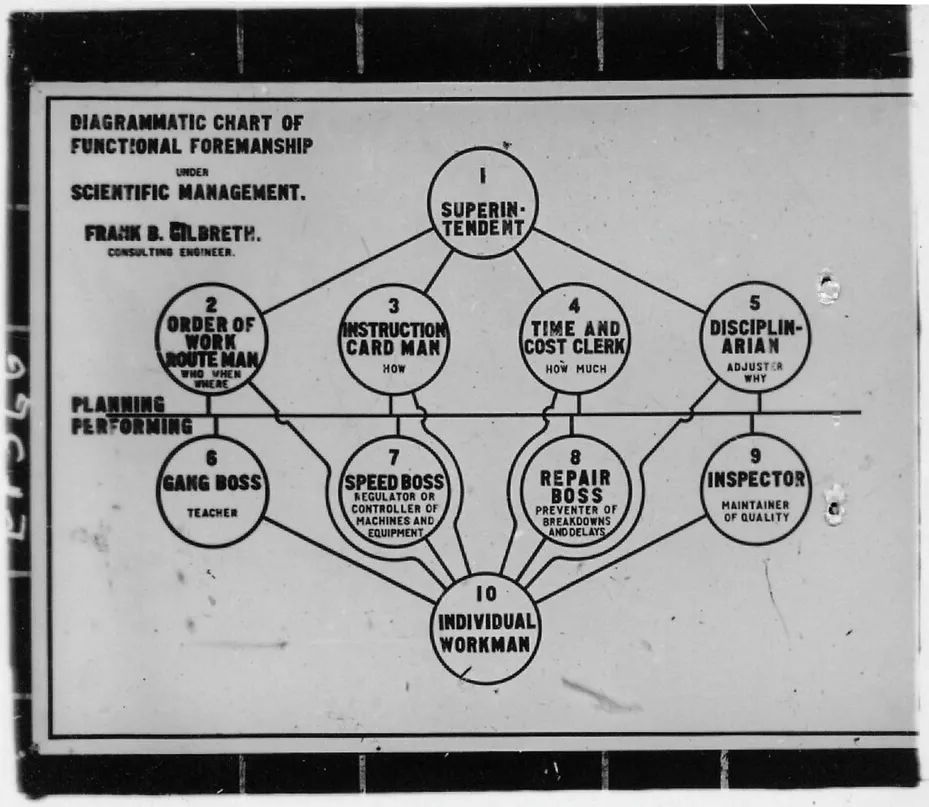
[Frank B. Gilbreth’s diagram of “functional foremanship” under scientific management, around 1915. The Gilbreths made their name writing down what workers did all day, precisely enough that anyone could repeat it: ten job titles, one chart. A century later, a job described that well is a job a model can be trained on. (Frank B. Gilbreth Motion Study Photographs, Kheel Center, Cornell University. Public domain.)]
On August 10, Steven Bartlett released an hour and 53 minutes of conversation with Seth Godin with a title built for the feed: “The Quitting Expert: You’ll REGRET Not Quitting Before AI Takes The Choice Away!” Yes, the title is noise. But inside it, Godin gives the best test I have heard for whether AI can take your job: you want a job where nobody can write down what you do all day (Gilbreth’s Motion Study).
I watched it multiple time, and sit thinking about it for a couple of days. Part of it is the best popular advice available on the subject. One central claim, repeated twice, is the kind of (dis)comfort that will cost people years: years spent feeling safe instead of changing direction. And the hardest problem facing the people hit first never comes up at all in the conversation.
Start with the test, because everything else is around it.
Most public advice still sorts work into routine and creative, then reassures the creative half. Godin’s category cuts across both. “A training set is the pile of examples a model learns from: here is the task, here is what a good result looks like, here is the correction when it goes wrong”. If someone can write down your tasks in that form, a model can be trained on the write-up, and the write-up does not care how the tasks were skilled. A junior analyst’s valuation model is skilled work; and it is also a sequence of steps with worked examples, which is all a training run needs.
Bookkeeping, tier-one support, junior contract review, the first pass of an audit: different skill levels, one thing in common. Their processes can be written down. The people following them are the first people hit.
Bartlett, at one point, reads Godin a Michael Jordan quote from a gym wall: “If you quit once, it becomes a habit. Never quit.” To which Godin answers: Jordan is wrong.
He has argued this since 2007, in his own The Dip, but the episode sharpnes the argument. Godin tells the story of the business he ran making DVDs for book publishers, and of the internet arriving to end it. Every day he spent defending that business, it was wasted. He thought he was in a dip, the hard stretch that ends if you push through, when he was standing at a wall, a business that would never come back no matter how hard he worked.
Never quit is advice for people who already know that the thing they are defending can be saved. The people whose job can be described, do not know that, and the not-knowing is the entire problem.
Two questions separate the dip from the wall:
- has anyone in your position made it through before? If yes, a dip is possible.
- is your task volume being reduced every quarter? If yes, you are at a wall, and you should quit while quitting still buys you time.
What the test leaves standing is judgment about the outcome: knowing when it is good enough, when it is confidently wrong, when the question itself was wrong. Nobody has written down how to make those calls. By Godin’s own test, work nobody can describe is work no model can be trained to do.
Godin says twice that “AI is never going to be able to replace networks of people.” and he means the real thing, people in a room, reading each other gestures and sights, the live flow of reasoning, two people changing each other’s positions, by being there, in the room. Ok, I give him all of it. No model replaces that in-person exchange, and I’ve seen nothing that suggests one eventually will.
The claim is true, BUT it will save nobody.
Nobody is paid for the conversation. People are paid for the work that flows through the conversation: the decision reached in the meeting, the deal shaped over dinner, the introduction that becomes a contract. AI does not need to replace the room to take that work; it reroutes the work around the room. Every decision a model pre-digests is a meeting means that that meeting no longer has to happen. Every summary is something that is not needed. The network remains fully human, gestures intact, however it carries less of the economy every year. AI offers comfort, but it doesn’t include protection.
So the question is not whether AI can replace your network; it is how much of your income still requires a room. That number can be raised on purpose, and this is where I would push past Godin.
Three moves make the room a hard requirement again:
Sign things. Accountability is a social arrangement. You are someone a client can trust, blame, fire, (or sue when things go wrong). A model can produce the audit but it cannot sign it, because signing means accepting consequences (kmnonw, or unknown), and there’s no one inside the model to accept them. This is why boards exist, why signatures exist, why professional insurance exists.
I have sat in enough post-incident rooms to know that the first question is never “what did fail this time?”, it is “who do we call now?”. Be the person grown into that question.
Vouch for people. An introduction where your reputation is the collateral cannot be automated, because a model has no reputation (for now) to defend. The vouch is expensive because you lose something when it goes wrong, and the cost is usually what gives it value.
Move real decisions into live/in-person conversation. A matter settled by exchanging emails is already inside a pipeline run by a model. A matter settled in the room, with the reasoning happening between people, is not. Whoever controls where the decision happens controls how much of it a model will carry.
Godin’s advice for making this move is “pick yourself”: stop waiting to be picked and step forward on your own. Uhm. He undersells what it costs. Most people in describable work chose that work on purpose. The deal was always “security” in exchange for “following the rules and staying off the hook”.
Signing, vouching, and deciding in the open all put you on the hook, and for many people that is a change of personality, not changing work/role. Godin concedes this much: possible, he says, but not easy. I’d go further. Possible, expensive, and for some people the wrong trade, and a honest advice should price it properly.
Which leaves the question never asked in the almost-two-hours episode.
Judgment, the safe ground in this whole argument, gets built one way: by doing thousands of describable tasks under supervision. Years of bad drafts, or redlined contracts, or peer-reviews by someone who has seen them all before. The repetitions are the training, and the training has only ever had one funding source: junior salaries paid for work that seniors could have done faster (and possibly better).
Those are exactly the tasks now being automated. The clearest evidence so far comes from payroll records. Brynjolfsson, Chandar, and Chen have been tracking ADP payroll data covering millions of US workers, and in their August 2026 update, employment of workers aged 22 to 25 in the most AI-exposed occupations stands 19% below where their less-exposed peers are.
The gap has widened steadily since they first measured it at 13% a year ago, and it comes from not hiring rather than from layoffs. Nobody is firing the juniors. Companies have stopped making them.
So the people hit first include the 24-year-olds who will never get to do the repetitions that were supposed to turn them into “seniors with judgment”. The safe ground has a supply chain, and the supply chain is being cut exactly while everyone is told to head for the safe ground.
Nobody has a good answer, me included. The options I can see”? Pay juniors to do the work, openly, as a training cost; maybe, train them on simulated cases instead of live ones; fund apprenticeships as true apprenticeships instead of masking them as cheap junior salaries. All three cost money, in the same quarter a model was bought to save on budget. And of course that is the why the juniors keep losing the budget meeting to a voice in the report that never has to argue for itself, AI.
And if companies refuse to pay? The cost moves to society, where it gets harder. Should schools take over the repetitions, teaching more practice and less theory? Practice takes years. School time gets longer while the payoff moves further out, and someone has to fund the extra years: the state, the families, or the employer who cut the training in the first place.
Everyone knows that training a junior was always partly a gift to your competitors, because trained people leave. A subscription does not leave, and it does not resign, and that is the full argument made in the budget meeting.
If judgment is what keeps humans employable, someone has to keep producing humans who have judgment. Right now every party with the money is possibly assuming someone else will.
Could someone write down what you do all day? That’s Godin’s question, and it tells you who gets hit first. The second question is mine: how much of your income still requires a room? And behind both, who are we training to stand in the room after us?
Answer the first two for yourself. The third one has to be answered by somebody with a budget, and as soon as possible, while there are still seniors left to do the teaching.
Marco Brondani writes on systems, surveillance, and the cost of being inside them. He is the author of The Split Problem: Why We Cannot Tell If AI Is Conscious (Quill House Press, 2026).
Sources
- The Diary of a CEO with Steven Bartlett, “The Quitting Expert: Michael Jordan Is WRONG About Quitting, Do This Before AI Comes! | Seth Godin,” August 10, 2026 (1 hr 53 min). All episode quotes, the Michael Jordan exchange, and the DVD business story. On Youtube
- Erik Brynjolfsson, Bharat Chandar, Ruyu Chen, “Canaries in the Coal Mine? Six Facts about the Recent Employment Effects of Artificial Intelligence,” Stanford Digital Economy Lab, August 2026 revision. ADP payroll data through June 2026; the 19% employment shortfall for workers aged 22–25 in AI-exposed occupations, driven by reduced hiring rather than separations; first documented at 13% in August 2025.
- Seth Godin, The Dip: A Little Book That Teaches You When to Quit (and When to Stick), Portfolio, 2007.